
This Dot Com Darling is back from the dead and absolutely FLYING on AI-supercharged wings
A No-Lose Household Name Investment with 7x Upside... it simply doesn't get better than this


Hi Wizards!
Platform Economics
By now you will gather that I am a major fan of platform economics.
When you own a business with fixed operating costs and few capex requirements plus a moat, you have a very powerful combination which can throw off jet streams of cash.
Combine that with a tip-of-the-tongue household name with net cash on its books and is currently super cheap and you have a multibagger set-up in spades.
Cheap as chips, chart we heart
Today the Wizard is going to put himself in your shoes, as an investment sleuth so to speak.
With this in mind let’s look at what cheap looks like, using first glance metrics you may be familiar with:

P/E (bottom row) is most investors’ go-to metric. Looking at the table, we can see P/E for this stock compressing from 7.1 (this year) down to 5.4 (2028). By all accounts, that looks pretty good value-wise, and tells us that the company is profitable and those profits are expected to grow. Check.
Now go up a bit higher and observe the Price to Free Cashflow ratio. That’s even lower! This is telling us that the company in this dataset is highly cash generative. Check.
Now go up to the first row and look at EV/FCF. That’s lower still, and falls to 1 in 2028! That’s telling us that this business isn't just highly cash-generative - it is sitting on a substantial net cash position. Double check.
When that EV/FCF multiple compresses down to just 1 x by 2028, it implies the company is projected to generate its entire underlying enterprise cost in a single year of free cash flow. This is extremely rare. As we noted in our Method to Magic post, the market is frequently ineffective at measuring value - but with a growing company in a net cash position this seems simply absurd. That is indeed what we’re seeing here.
So we see a reasonable-looking headline P/E masking a deep-value, cash-rich balance sheet. Investors are effectively getting the company’s operating assets for pennies on the pound. The company is debt free, cash-rich, profitable, cash generative and by the metrics completely misvalued. It’s too good to be true… something must be wrong surely?
The Chart we Heart
Before we address that question, let’s have a look at the chart.
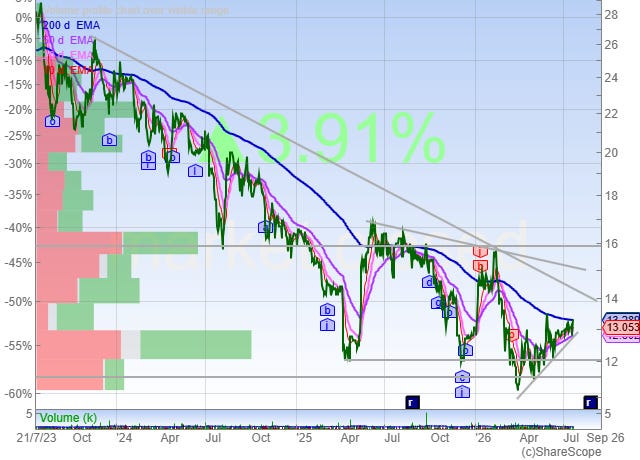
Over the last three years we see it has fallen in a long choppy downtrend… but now there are signs of life with a confirmed bounce: the share price has snapped through what looks like a double bottom round about the 12 mark, and which now provides the share a powerful line of support.
Let’s zoom in. We can see the share price is now heading up towards that diagonal upward resistance line (which goes back to October 2024) followed by another overhead resistance line at the 15 mark. Then (refer to the first chart) another, horizontal resistance line going back to September of 2022 at the 16 mark.
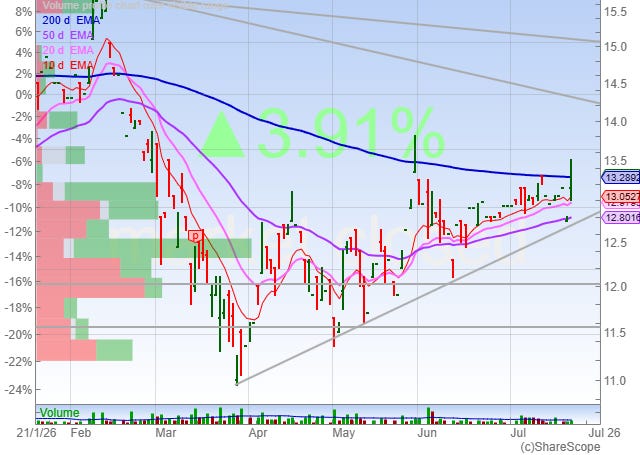
If it breaks through these resistance lines, what do you think will happen to the share price?

So it’s cheap - desperately cheap - cashed up and in an uptrend with plenty of altitude to climb into. What’s the business and why is it printing at such great value?
lastminute.com NV #LMNZ $LMNZ Sp: CHF 13.30 Mcap: CHF 141.1m
Upside: 7x
Sometimes it feels like we travel full circle in the investment world as we do in life.
Back in the day, lastminute.com was a dot com darling until its share price blew up shortly after its London listing in the halcyon days of the late nineties and became one of the first ever dot bombs. Fast forward to today and we now see it as a high-margin pioneer of AI in the travel industry.
Throughout all its trials and tribulations, lastminute.com has always been synonymous with travel. The company has been through it all. Takeovers, fraud investigations, boom and (nearly) bust (it has never gone bankrupt). Somehow it has managed to keep going.

Travel is what it still does today, but it has metamorphosed. Being able to survive through these trials and tribulations has left lastminute.com with a very valuable competitive toolkit which gives it a moat, as we will come on to see. Today it sits on the cusp of another tech-driven renaissance.
Fasten your seatbelts ladies and gentlemen as we unpack lastminute.com’s value proposition and place in the global travel market...
The Business Model Transformation: From Flight Broker to High Margin Virtual Tour Operator
While the company has stayed true to its travel operator roots, we can forget everything we remember about lastminute.com from the early 2000s. The company is no longer just a middleman scraping wafer-thin 5% margins on single airline tickets.
Over the past few years, management executed a quiet but radical pivot toward Dynamic Holiday Packages. Instead of selling stand-alone flights or hotel rooms, their platform dynamically bundles flights, accommodations, transfers, and activities in real time - kind of like a one-stop holiday engine that automatically glues the entire trip together in a single click.
This has transformed the unit economics in the following ways:
Zero Inventory Risk: As a 100% asset-light ‘Virtual Tour Operator,’ lastminute.com doesn’t own a single hotel bed or plane seat. If a flight flies half-empty, the airline takes the hit - not lastminute.com.
Superior Take Rates: On standalone flights, an OTA earns tiny commissions. On dynamically bundled holiday packages, the group commands take rates exceeding 12%. That’s highly respectable in the travel industry.
Defensive Geographic Foundation: Steady, highly profitable Core Markets (UK, France, Germany, Italy, Spain) generate 72% of revenues and fund rapid expansion into high-growth Expansion Markets (Nordics, Benelux, Ireland, Switzerland).
Where Regulations create a ‘Complexity’ Moat
At this point we have to answer a key question: Is a travel software API an actual moat, or just another (commoditised) bog standard plugin to a travel site?
Let’s be clear about this. If lastminute.com’s advantage was simply writing software code to connect travel databases, anyone with a decent engineering team could replicate it. Software code on its own is easy to copy.
The real, un-copiable moat isn’t in the code but built deep within the complex, legal world of European travel regulation. Remember the point earlier about lastminute.com retaining invaluable elements from its past? Well here we see it, and it’s a powerful moat:
The ‘Tour Operator’ Iron Curtain & Margin Maker: Under European law (the Package Travel Directive) and UK ATOL frameworks, combining a flight and a hotel legally transforms a company into a ‘Tour Operator’. These two words actually have major consequences. Tour operator status requires posting millions in financial bonds, securing multi-country licenses, and accepting strict, non-negotiable legal liability for consumer safety and refunds. Lastminute.com hold the physical, multi-country regulatory licenses and have posted the millions in financial bonds required to do this legally. This means they can legally sell dynamically bundled packages, allowing them to capture those hefty 12%+ margins we spoke of earlier rather than the razor-thin 5% margins of standard flight brokers.
Absorbing Real-World Friction - where there’s muck there’s brass: Travel is messy. When bad weather strikes, airlines cancel flights, or regional conflicts disrupt travel, software cannot magically fix a stranded passenger.
Lastminute.com does though. They have spent 25 years building the physical customer-care infrastructure to handle emergency repatriations, refunds, and legal liability. So while pure software platforms and AI startups don’t want to take on this physical liability due to the costs and hassle, by owning the ‘messy’ real-world compliance lastminute.com creates an insurmountable barrier to entry that new tech startups cannot simply code their way around.
Why Even Giants Rent lastminute.com’s pipes: Building and maintaining this legal and licensing infrastructure across fragmented European markets is such an onerous task that even global travel giants like Booking.com rely on lastminute.com’s fulfilment engine to handle their dynamic holiday packages in key European territories. You read that right - Booking.com uses lastminute.com as its backend.
What this means for lastminute.com
This regulatory moat translates directly into a multi-layered strategic advantage that protects their bottom line:
1. Insurmountable Barriers to Entry for Tech Startups A new tech startup can easily build an app to scrape flight prices, but they cannot legally sell a bundled European holiday package without posting millions in regulatory bonds and building a customer liability team. lastminute.com owns the hard, physical licences that pure tech companies desperately want to avoid, making them the default partner for any platform wanting to sell European leisure travel.
2. A Hidden B2B Revenue Engine Because global giants like Booking.com do not want to deal with European Package Travel Directive compliance or ATOL obligations, they simply plug into lastminute.com’s backend system. This means that even when a consumer books a European flight-plus-hotel package on Booking.com, lastminute.com is the legally bonded entity processing the transaction and taking a cut of the revenue. They are effectively generating volume off their competitors’ marketing spend. This is a very strong position to be in.
3. The Ultimate Fulfillment Engine for AI As the booking journey inevitably shifts toward conversational AI, these platforms will need a licensed, bonded entity to fulfill the trips. Because lastminute.com has already spent 25 years building this regulatory ‘steel vault’, they are perfectly positioned to be the invisible, high-margin transaction engine powering the future of AI travel booking.
Competitive Matrix: How the Field Stacks Up
Let’s look at where lastminute.com sits in the broader competitive landscape by comparing it against both global giants (Booking.com, Expedia) and local European peers (On The Beach, eDreams, ODIGEO):
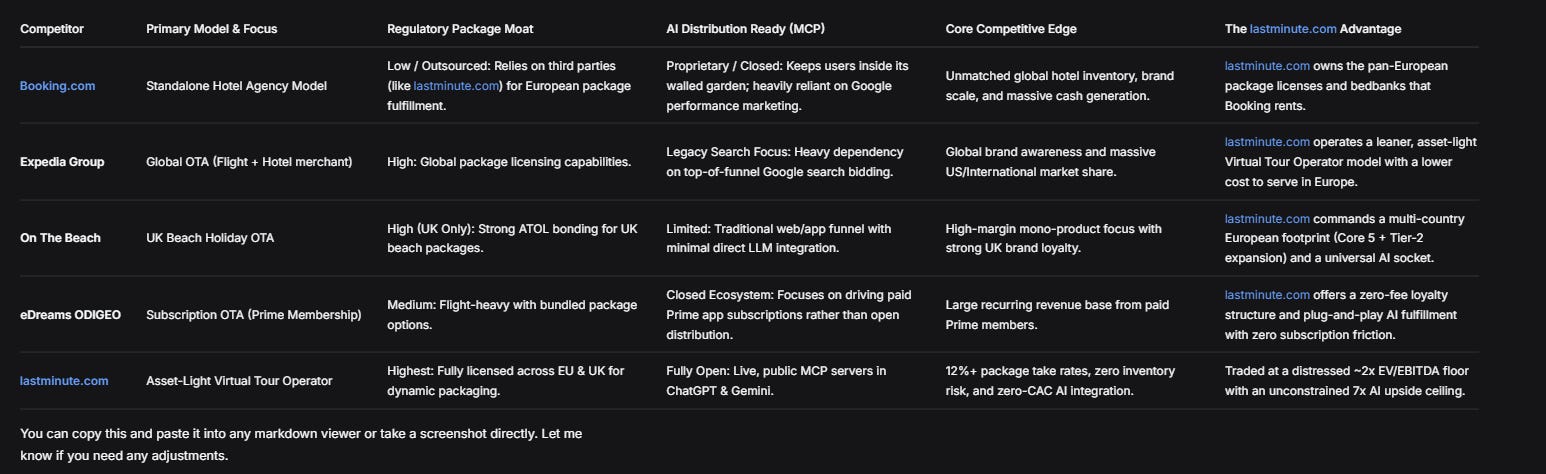
In the table above we can see why lastminute.com occupies such a highly defensible, un-copiable sweet spot across the European travel landscape.
While massive global leviathans like Booking.com dominate the market on volume, they lack the complex regulatory rails required to package flights and hotels legally in Europe. This structural gap literally forces them to rent lastminute.com’s fulfilment engine to process their European dynamic packages. Conversely, regional European peers are either trapped in single-country silos (as On The Beach is), or they are forcing customers into high-friction, paid subscription walls which is eDreams’ business model. Competitors are literally in a ‘stuck or subscribe’ business model world which lastminute.com is not beholden to.
From this we can see that lastminute.com is the only player that successfully marries pan-European regulatory package licensing with a completely open, zero-friction AI distribution socket. That is quite something.
So while anyone can build a website to query flight prices, lastminute.com’s pan-European legal licensing, regulatory bonding, and dynamic package fulfilment architecture form a massive steel vault around their business - a vault that both AI agents and global travel giants need to plug into.
Verdict - durable moat and tollbooth identified. Check.
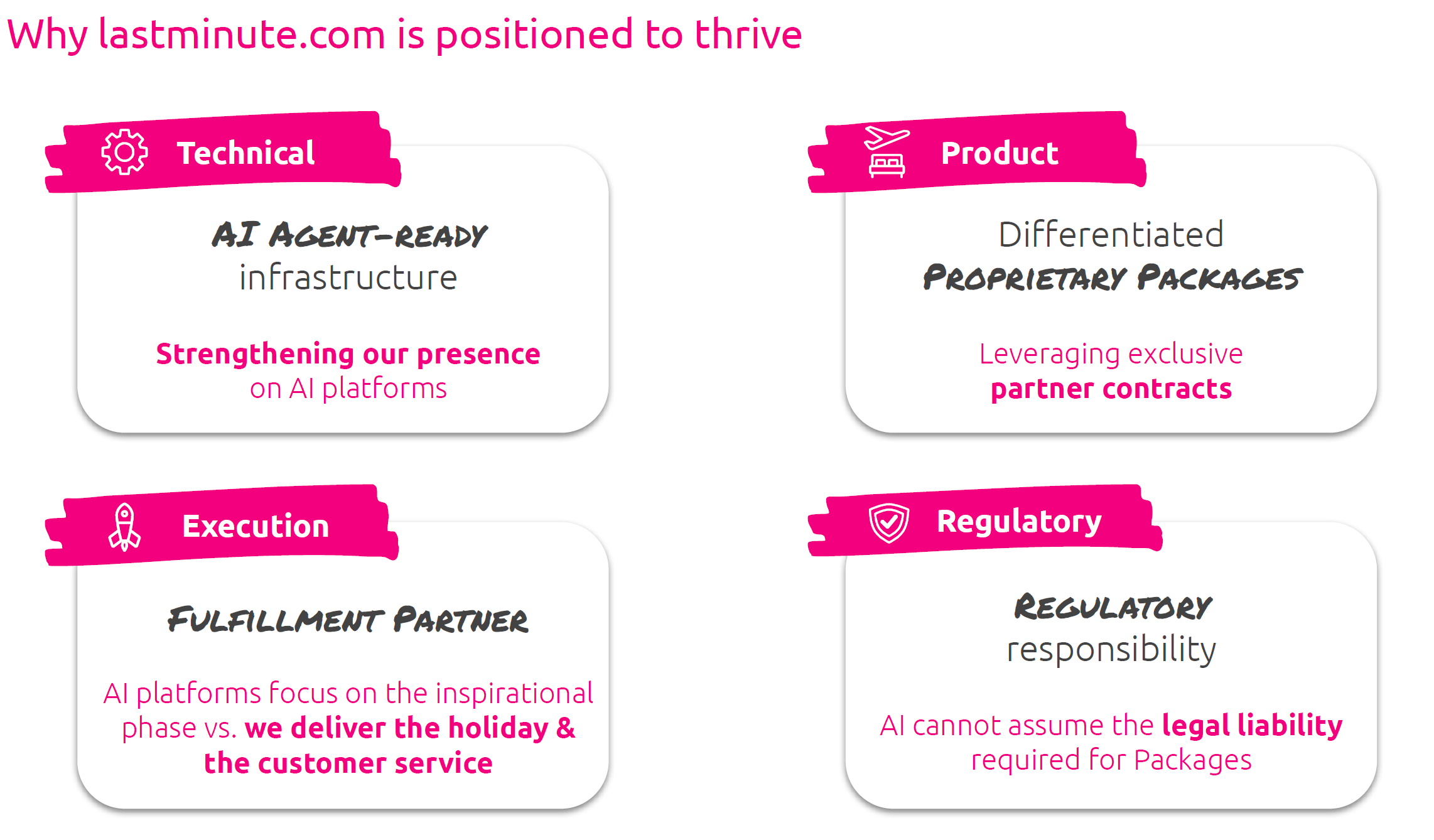
The AI Wings: Bypassing the Google Toll Booth
So much for the moat attributes that lastminute.com owes to its dot com heritage. What about its place in the future and in a world shuddering to the ructions of AI disruption?
This is where the thesis gets truly exciting - and where AI is like kerosene to lastminute.com’s afterburners, giving it wings.
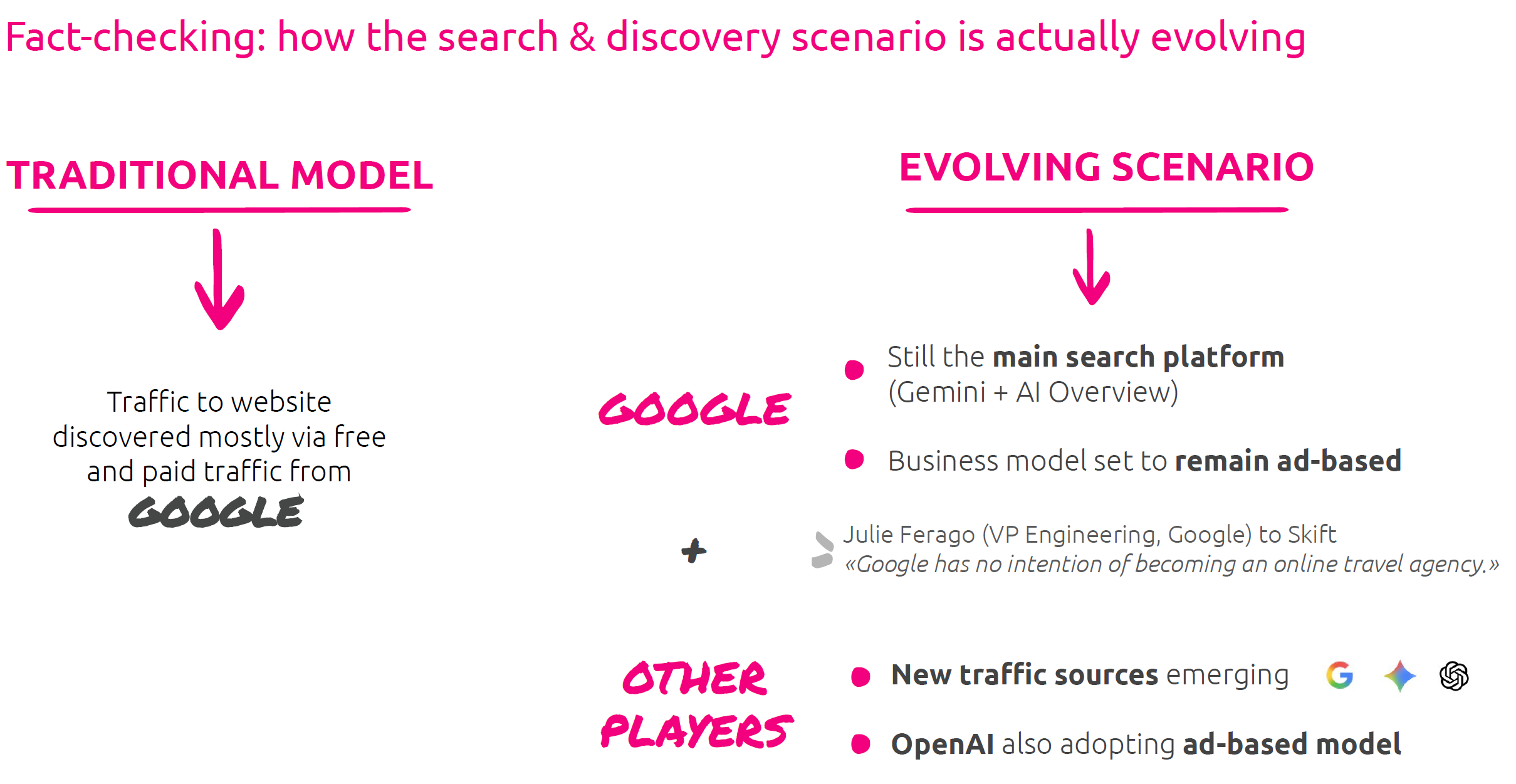
Historically, Online Travel Agencies (OTAs) have been trapped in an endless, multi-billion-dollar bidding war against Google Search. To get a customer to book a holiday, OTAs had to pay Google a massive chunk of their gross profit just for the click.
lastminute.com has built a structural way out: The Model Context Protocol (MCP) Server. See below:
This = high margins:
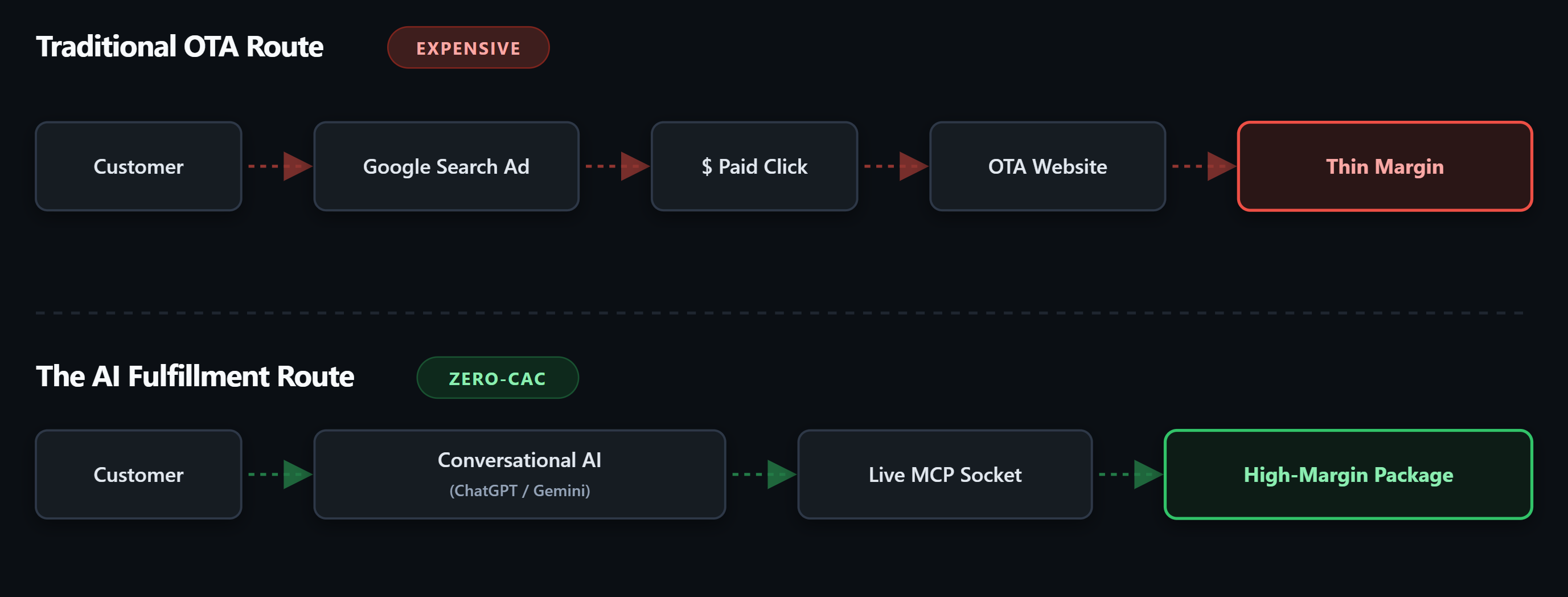
Instead of trying to force users onto their website, lastminute.com has open-sourced its backend directly into the world’s leading Large Language Models (LLMs):
OpenAI (ChatGPT): Live flight inventory went operational inside ChatGPT, allowing AI agents to pull real-time travel data directly from lastminute.com’s server.
Google Gemini Enterprise: Google Cloud has integrated a native ‘LastMinute data store’ directly into Gemini Enterprise documentation, allowing conversational queries to query flight, hotel, and package inventory seamlessly.
Anthropic (Claude): Their public MCP server endpoint is officially listed on the Anthropic Marketplace for developer integrations.
When a user tells ChatGPT, ‘Book me a 4-day sun getaway to Mallorca under €600,’ the AI doesn’t send the user to a Google ad. It queries lastminute.com’s live MCP endpoint, retrieves the dynamic package, and hands the customer directly to checkout.
Travel arrangements - as most of us know - are rarely ‘one shot’. We have various specifications and unique requirements. Google (and all search engines) simply do not work like this. They are ‘one shot’ in nature.
AI is not. It is conversational and can manage multi-factor, multi-step complex requirements:
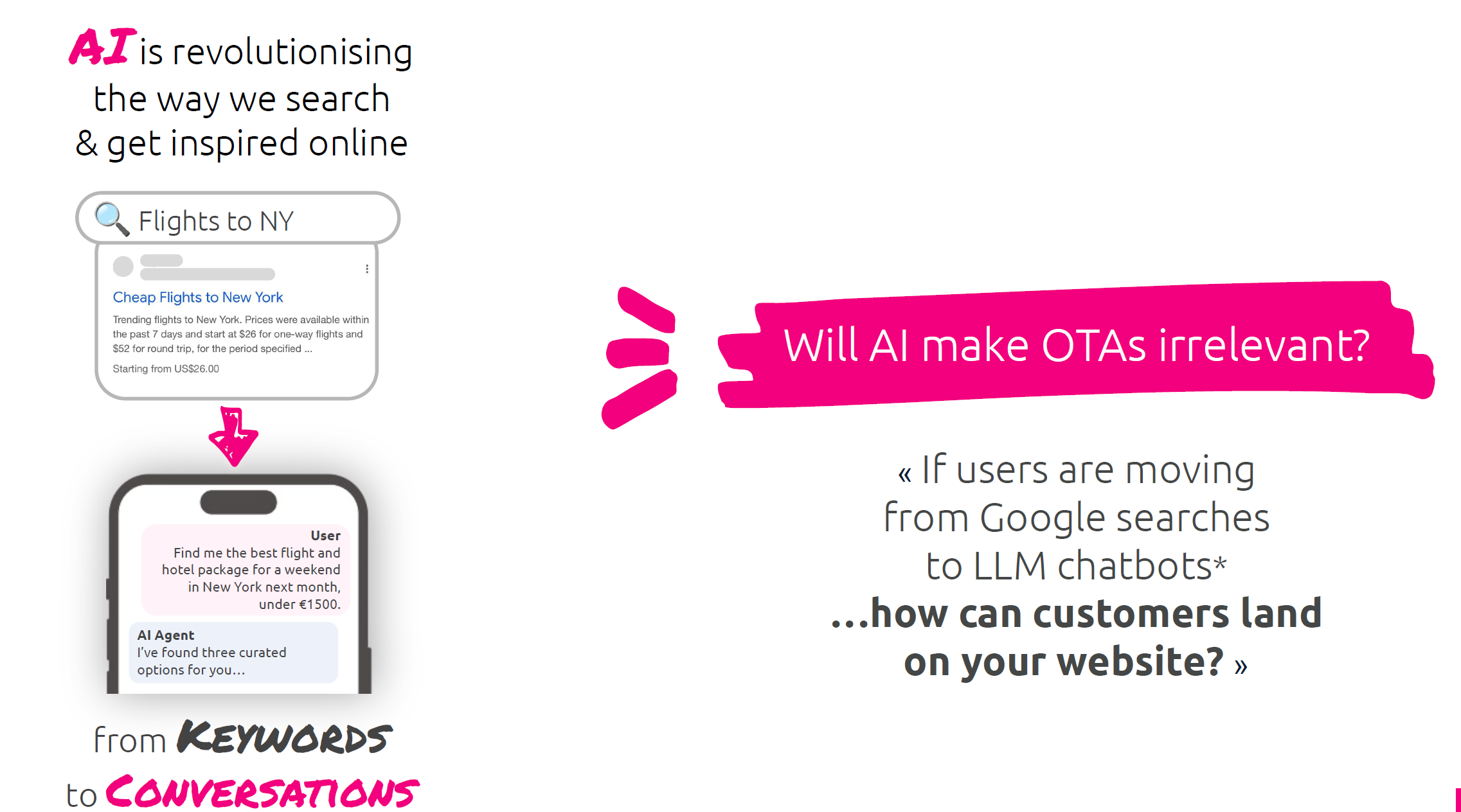
But AI cannot perform the booking by itself. It needs a back end.
The back end is the valuable bit then. And guess who has that?
So again, we can see how lastminute.com is able to weaponise / monetise its back end, in this case farming it out to AI agents at the same time bypassing Google’s ad toll booth, allowing gross profit to drop straight to the bottom line.
→ AI is absolute kerosene to lastminute.com.
Radical Operating Leverage & The Cash Machine
A tech moat is useless if your corporate overhead eats all the profit. Management understands this and has been purposefully reducing fixed costs.
The 25% Overhead Cut: In mid-2026, the group executed a structural reorganization, reducing its workforce by 25% to deliver €16 million in annualized cost savings by 2027. Fixed overhead is now firmly capped.
The Working Capital Float: Because customers pay upfront when booking a package but lastminute.com settles with hotel and airline partners post-travel, accelerating booking volume manufactures massive, non-dilutive negative working capital float.
Fortress Balance Sheet: The group sits on €115.7m in gross cash with €71.2m in net cash. They have zero net debt, no funding treadmill, and generate immediate positive free cash flow. That’s over 55% of the company’s mcap in net cash!
With fixed overheads frozen, every euro of incremental revenue generated through these direct AI channels triggers intense operational gearing. We are already hearing the ka-ching sounds from our favourite platform economics now folks!
Addressing the Friction: Customer Experience (CX)
We must be honest about where the operational friction lies. Public review analytics show a clear division: pre-purchase booking UX is fast and smooth (Trustpilot ~4.0/5.0), but post-purchase service recovery during major disruptions historically suffers. When flights are delayed or cancelled, customers can get trapped in rigid chatbot loops.
Management has thus decided to reinvest capital into server-side LLMs. By replacing primitive, rule-based chatbots with advanced AI agents, the group is automating complex re-protection and refund workflows. We explicitly model a structural ~7.5% tech CapEx profile going forward to fund this automated customer service layer and permanently protect brand equity, meaning we are cutting some of the upside to safely accommodate the capex for their full-cycle CX enhancements.
Again, we can see a company well-positioned to be an AI Winner.
The No-Lose 7x Multi-Bagger Asymmetry
The equity market is currently pricing lastminute.com with an implied Present Value of Growth Opportunities (PVGO) of -99.4%. The market is pricing this business as if it is in terminal desktop-era decline, completely blind to the fact that its digital plumbing is already live inside Gemini and ChatGPT.
I’ve got no other way to put this - it’s nuts - And with more than half the company’s Mcap in cash too!
Forward Projections
Let’s have a look at the forward growth we can expect to see from lastminute.com using our predictive Bayesian modelling:
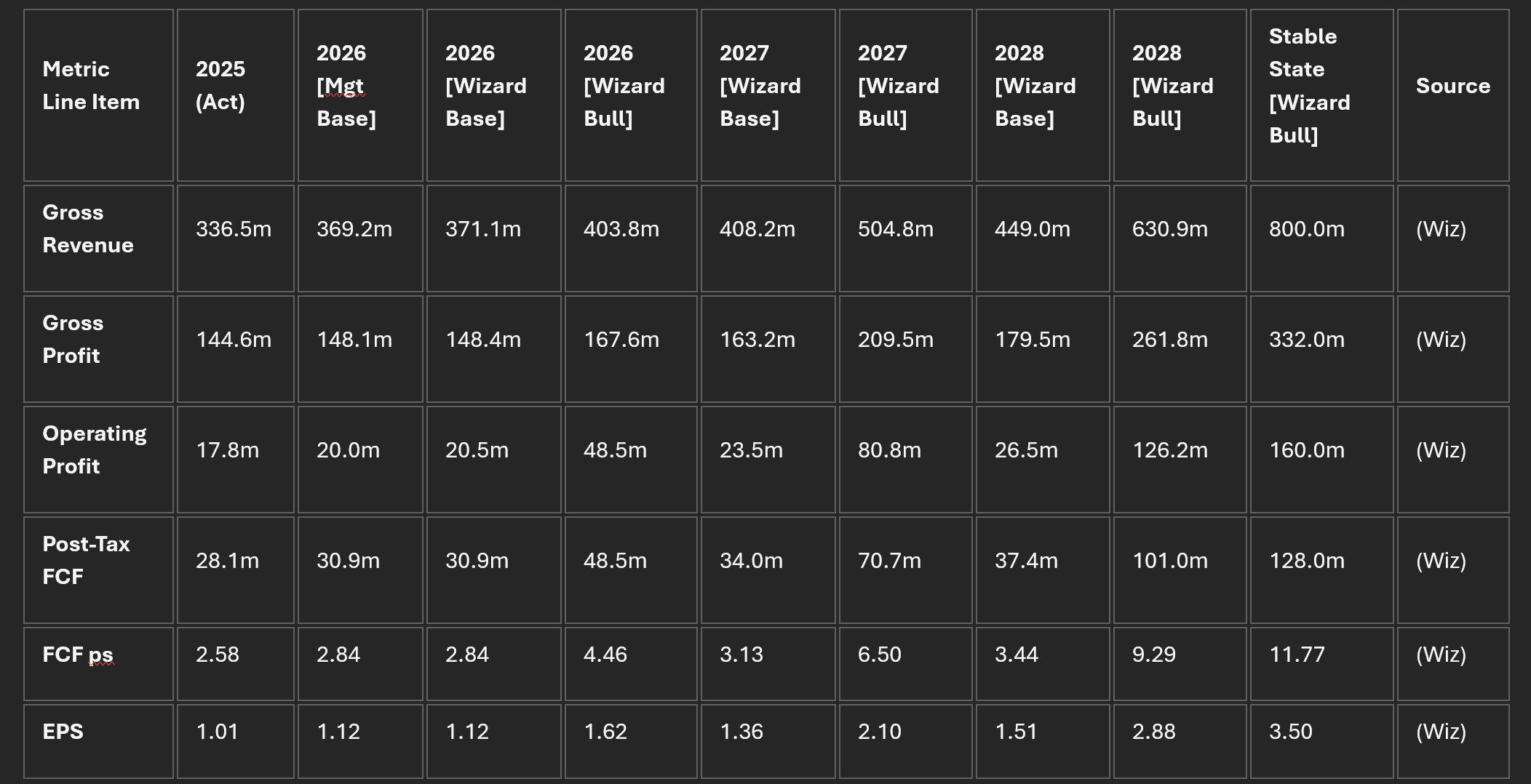
We have split the projections into our standard Wizard Base Case (assuming management simply hits their boring, linear 10% growth targets) and our Wizard Bull Case (where the zero-CAC, AI-supercharged distribution engine takes over, per our predictive assessment).
Notice how the numbers really start to fly as we move into 2027 and 2028:
The Baseline Cash Machine: Even if the AI disintermediation completely fails and lastminute.com just plods along as a traditional OTA, the business is still a cash-printing machine. Under the Base Case, Post-Tax Free Cash Flow (FCF) steadily climbs from 28.1m to 37.4m by 2028. You are buying a highly resilient, cash-generative floor.
The Magic of Zero-CAC (Bull Case): Look at the divergence in 2028. Between the Base Case and the Bull Case, Gross Revenue increases by roughly 40% (from 449.0m to 630.9m). But because the company has capped its fixed overhead through the recent 25% workforce reduction, that incremental revenue doesn’t get eaten by marketing or admin costs. It drops straight to the bottom line…
…Explosive Profit Multipliers: That 40% bump in top-line revenue triggers a massive 4.7x explosion in Operating Profit, rocketing from 26.5m in the Base Case to an astounding 126.2m in the Bull Case.
Per-Share Value Creation: For shareholders, the metric that matters most is FCF per share (FCF ps). If the direct LLM distribution socket scales as anticipated, cash generation per share nearly quadruples from current levels, hitting 9.29 by 2028.
Let’s hear it again please…
Valuation
Let’s now look at how the market is currently mispricing this dynamic.
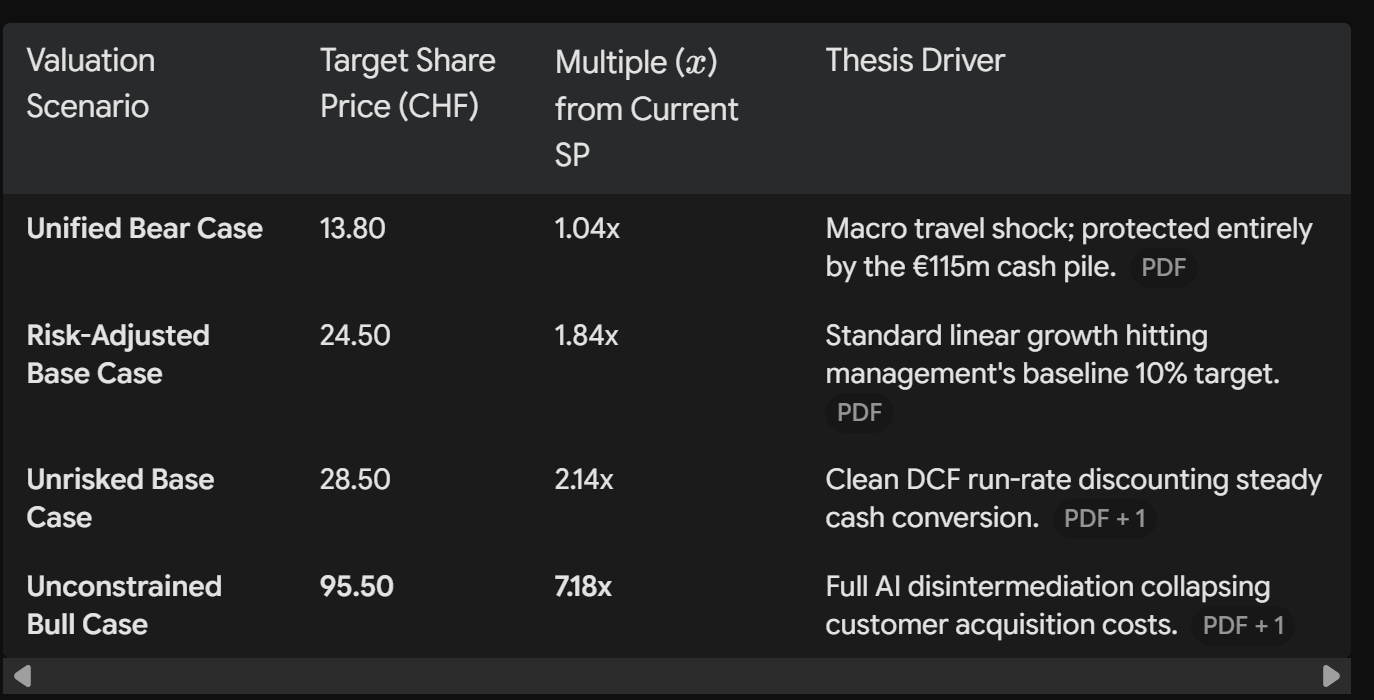
Here is how our scenario probability tree breaks down:
The ‘No Lose’ Unified Bear Case (Target: 13.80 CHF) - The Concrete Floor Even in a scenario where severe macro travel shocks hit and booking volumes flatten, the downside is completely insulated. Why? Because the group is sitting on a fortress balance sheet with €115m in gross cash and zero net debt. The market price is sitting below our absolute worst-case scenario. At current prices, you are practically buying the cash pile and getting a profitable European travel network thrown in for free.
The Risk-Adjusted Base Case (Target: 24.50 CHF) - The Margin of Safety This is our conservative anchor. If the grand AI disintermediation thesis completely flops, and management simply grinds out their stated 10% baseline growth targets while still paying the Google ad-bidding toll booth, the stock is still worth nearly double its current price (an 86% upside).
The Unrisked Base Case (Target: 28.50 CHF) - The Normalised Engine A clean, un-haircut Discounted Cash Flow (DCF) projection. This scenario models the steady-state cash conversion of their 12%+ margin virtual tour operator business as they successfully scale into their Tier-2 Expansion Markets (like the Nordics, Switzerland, and DACH regions) without severe macro interruptions.
The Unconstrained Bull Case (Target: 95.50 CHF) - The 7x AI Multi-Bagger This is where the maths goes parabolic. If their live MCP sockets inside Google Gemini and OpenAI trigger widespread, direct conversational bookings, top-of-funnel Customer Acquisition Costs (CAC) collapse. Because their fixed overhead is already capped following their 25% workforce reduction, this zero-CAC revenue drops straight into free cash flow. This is the scenario that turns a deeply discounted value stock into a 7x multi-bagger.
The Verdict
You have a business with:
Zero net debt and €115m in gross cash.
A 12%+ take rate asset-light model.
A capped fixed-cost base dropping cash straight to the bottom line - platform economics.
Live, functional AI fulfillment plumbing wired into OpenAI and Google.
Heck, lastminute.com even pays a safe and growing dividend, paying investors an estimated 3.7% forward yield for 2026, projected to scale up to 5.2% by 2028
And yet, the stock trades at an EV/FCF of just over 2x, heading toward 1x by 2028… Mamma Mia!
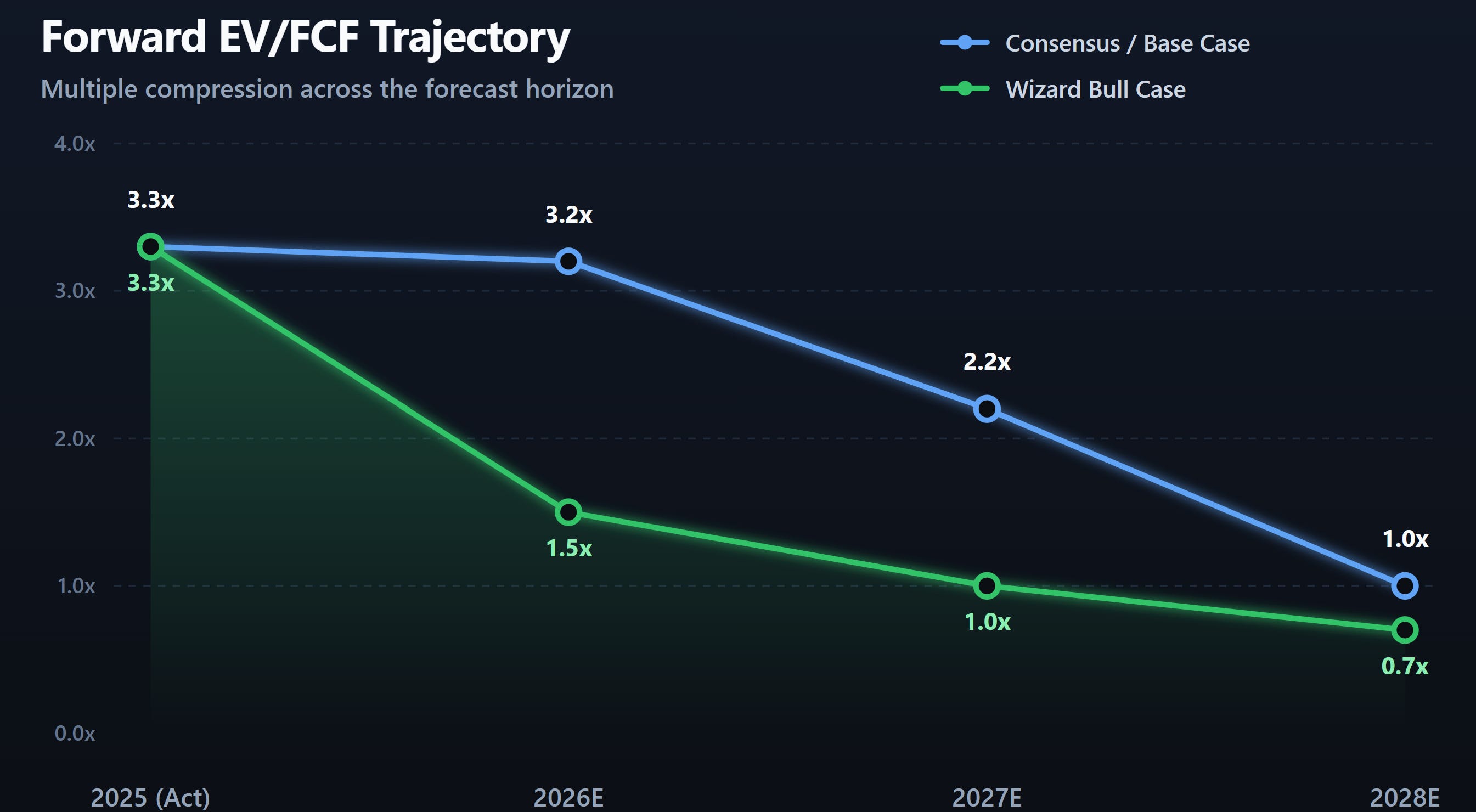
The downside is structurally floored by net cash, while the upside ceiling offers a 7x multi-bagger return as conversational AI travel booking explodes.
This is one of the most asymmetric setups we have seen all year. Buy before the rest of the market realises this dot-com pioneer is running the backend for the next decade of AI travel.
Stay magical, Wizards!
If you have found this analysis valuable please Like, Restack or share with friends, thank you!
Follow me on X here: Wizard of Windsor